Layout sample · for review
Siberian Federal University, Krasnoyarsk, Russia
Translation from the Russian original. Passages marked in the text are pending author review.
Introduction
Abstract. A study of ore mineralization in intrusive rocks of the Kiya-Shaltyr urtite deposit (Kuznetsk Alatau) found a range of minerals, from oxides through noble-metal minerals to palladium phases, in “scanned rocks” (the wording in the Russian source) associated with the emplacement of a gabbroid stock. The rare complex sulfide djerfisherite was identified. Its distribution and relationships with other minerals provided a basis for several conclusions about its origin. The description of the host rocks requires confirmation by the author.
Keywords: ore mineralization, djerfisherite, Kiya-Shaltyr massif, gabbroids, urtites, rims, cubanite, hematite, magnetite, sulfides, chemical composition.
Observations and figures
Djerfisherite occurs in massive pyrrhotite ore along the boundary between pyrrhotite and porphyritic inclusions of rock-forming minerals (Fig. 1).
Djerfisherite forms circular or elliptical rims measuring up to 0,22×0,26 mm, overgrown by pyrite and chalcopyrite on both the pyrrhotite side and the rock-forming mineral side. The djerfisherite rims are highly fractured. Thin veinlets of magnetite and hematite replacing it penetrate these fractures. Small relics of chalcopyrite and cubanite occur within the djerfisherite rims. These minerals are assumed to be replaced by djerfisherite. The chemical composition of djerfisherite is presented in the table.
Calcite, apatite and monoclinic pyroxenes dominate among the rock-forming minerals of the inclusions. Biotite, olivine, rutile, chlorite and perovskite were recorded in isolated cases.
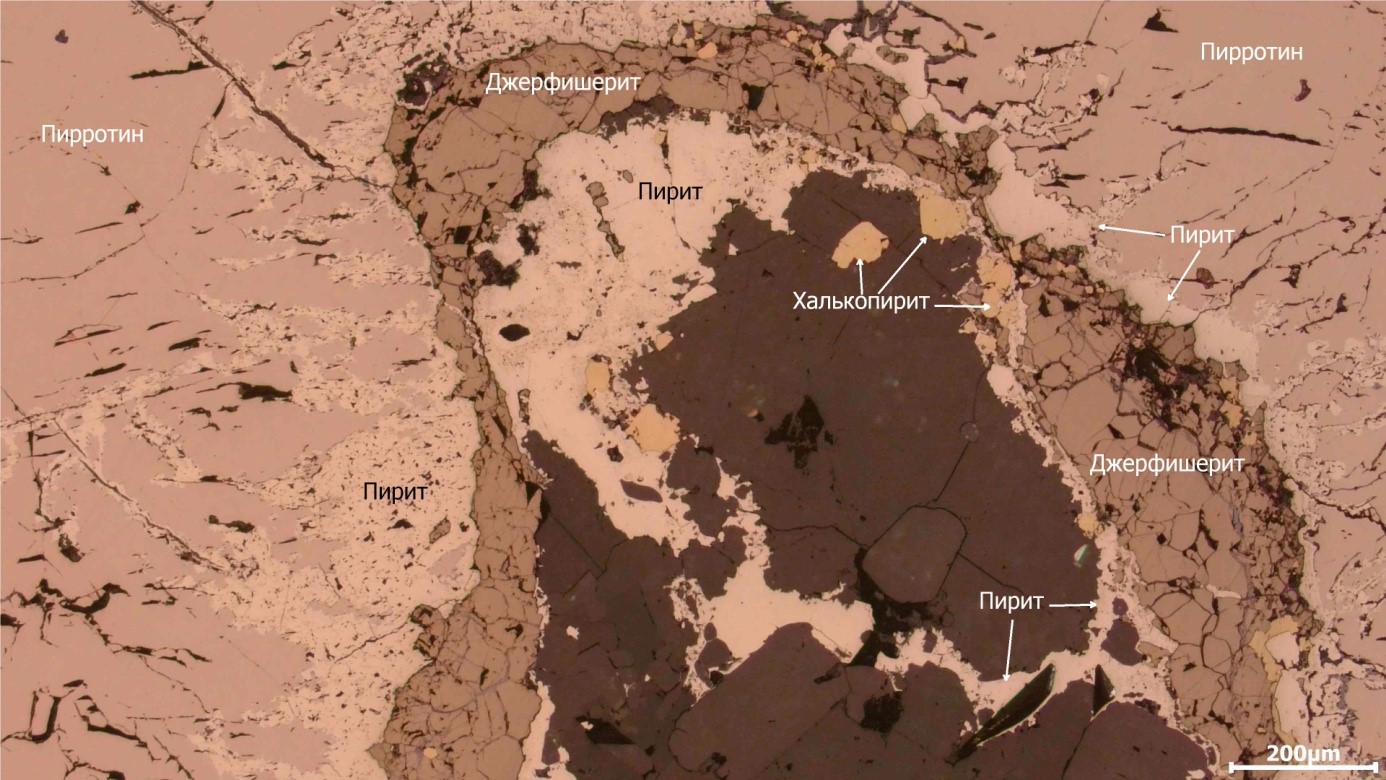
The micrograph retains its original Russian labels: Джерфишерит = djerfisherite, Пирротин = pyrrhotite, Пирит = pyrite, Халькопирит = chalcopyrite. Scale bar: 200 µm.
Chemical composition
The table scrolls horizontally. Select a figure to open it at its original size.
| Spectrum | Contents, wt. % | Total | Formula | |||||
|---|---|---|---|---|---|---|---|---|
| S | Cl | K | Fe | Ni | Cu | |||
| 3 | 31,73 | 1,45 | 9,20 | 34,73 | 1,92 | 20,55 | 99,57 | K5,98(Fe15,80Cu8,21Ni0,83)24,84S25,14Cl1,04 |
| 4 | 31,87 | 1,34 | 9,25 | 35,01 | 1,40 | 21,04 | 99,91 | K5,99(Fe15,88Cu8,39Ni0,60)24,87S25,18Cl0,96 |
| 5 | 32,15 | 1,32 | 9,29 | 34,82 | 1,96 | 19,94 | 99,49 | K6,03(Fe15,81Cu7,96Ni0,85)24,61S25,42Cl0,94 |
| 27 | 33,80 | 0 | 6,73 | 38,06 | 5,18 | 13,52 | 97,29 | K4,44(Fe17,59Cu5,49Ni2,28)25,35S27,20 |
| 28 | 34,05 | 0 | 6,48 | 38,86 | 6,24 | 12,04 | 97,67 | K4,26(Fe17,87Cu4,87Ni2,73)25,475S27,27 |
| 29 | 34,14 | 0 | 5,97 | 39,07 | 6,54 | 11,74 | 97,46 | K3,93(Fe18,02Cu4,76Ni2,87)25,64S27,42 |
| 40 | 31,57 | 1,35 | 9,03 | 35,01 | 3,21 | 19,47 | 99,63 | K5,87(Fe15,94Cu7,79Ni1,39)25,12S25,04Cl0,97 |
| 41 | 32,05 | 1,38 | 9,12 | 35,54 | 3,10 | 18,46 | 99,65 | K5,91(Fe16,11Cu7,35Ni1,34)24,80S25,31Cl0,99 |
Note: analyses were performed at the Nornickel R&D Centre and Siberian Federal University using a TescanVega SBH scanning electron microscope equipped with an Oxford X-Act EDS analyser (Krasnoyarsk; analysts S. A. Silyanov and B. M. Lobastov).
In terms of chemical composition, this djerfisherite belongs to the iron-copper variety characteristic of urtites of the Khibiny massif [1] and charoitites of the Murun massif [2].
Conclusions
Djerfisherite is in turn assumed to be replaced by hematite (Fig. 2).
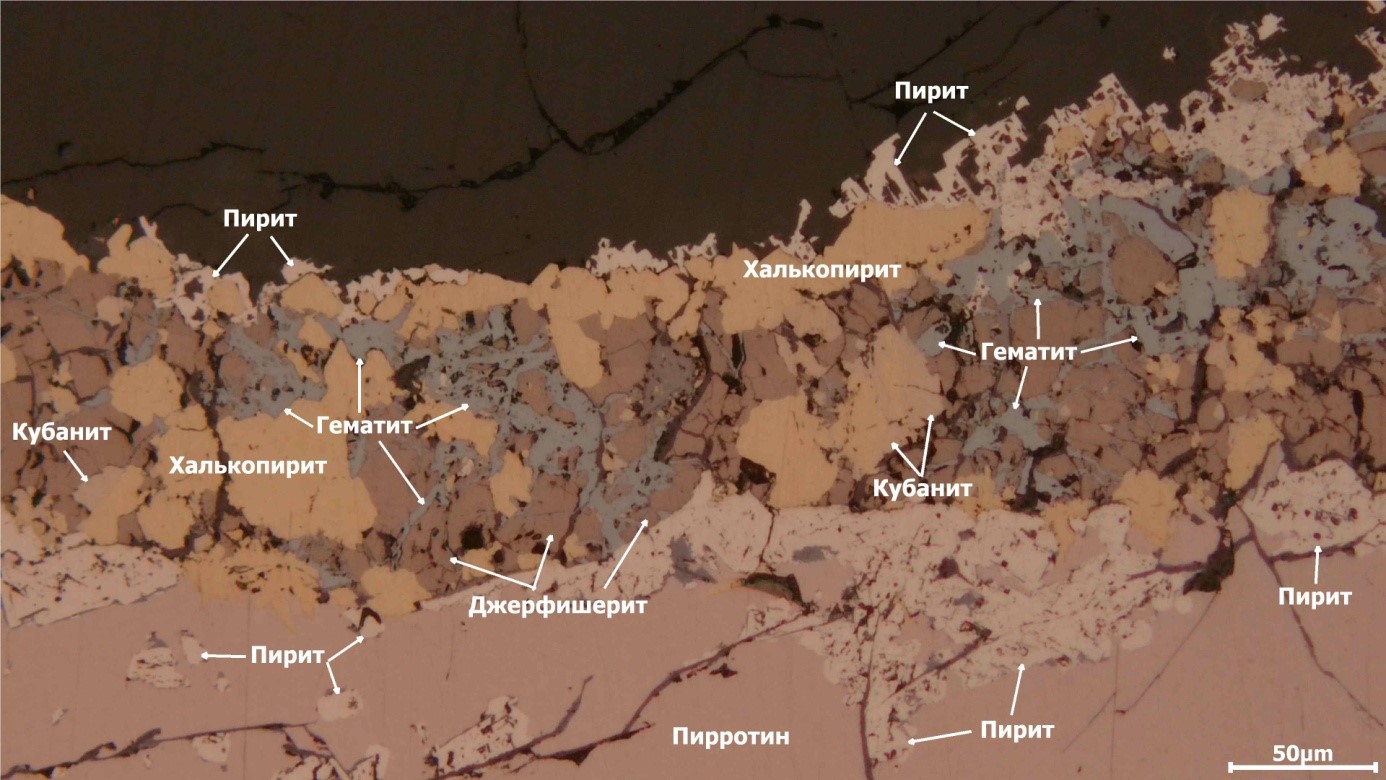
The micrograph retains its original Russian labels: Джерфишерит = djerfisherite, Пирротин = pyrrhotite, Пирит = pyrite, Халькопирит = chalcopyrite, Кубанит = cubanite, Гематит = hematite. Scale bar: 50 µm.
References
- Konev A. A., Vorobiev E. I., Lazebnik K. A. Mineralogy of the Murun alkaline massif.
Bibliographic entry in the original language
Конев А.А., Воробьев Е. И., Лазебник К.А. Минералогия Муранского щелочного массива. Новосибирск: Изд–во Сибирского отделения Российской академии наук, НИЦ ОГГ, 1996. — 221с. - Nazarov Yu. V., Krinov D. I., Sokolova M. N. Structural and genetic relationships between djerfisherite and bartonite and the problem of isomorphism in the djerfisherite–copper djerfisherite–bartonite system.
Bibliographic entry in the original language
Назаров Ю.В., Кринов Д.И., Соколова М.Н. Структурно-генетическая взаимосвязь джерфишерита и бартонита и проблема изоморфизма в системе джерфишерит-«Медь-джерфишерит»-бартонит// Геология и геофизика. Новые данные о полезных ископаемых. М., 2006, выпуск 41, с. 98-107.
English abstract supplied with the original
English abstract
DJERFISHERITE OF THE KIYA-SHALTYRSKY MASSIF (KUZNETSK ALATAU)
Koulemou L. T., Shvedov G. I.
Siberian Federal University, Krasnoyarsk, Russia
Annotation: When studying the ore mineralization of intrusive rocks of the Kiya-Shaltyrsky urtite deposit (Kuznetsky Alatau), many interesting minerals were found in scanned rocks associated with the introduction of the gabbroid stock, from oxides through noble to palladium phases. One of the rare minerals, jerfisherite, a complex sulfide was discovered, its placement and ratio with other minerals allowed us to draw several conclusions about the origin.
Keywords. Ore mineralization, jerfisherite, Kiya-Shaltyrsky massif, gabbroids, urtites, borders, cubanite, hematite, magnetite, sulfides, chemical composition.
Related material: report on waste from the Achinsk Alumina Refinery